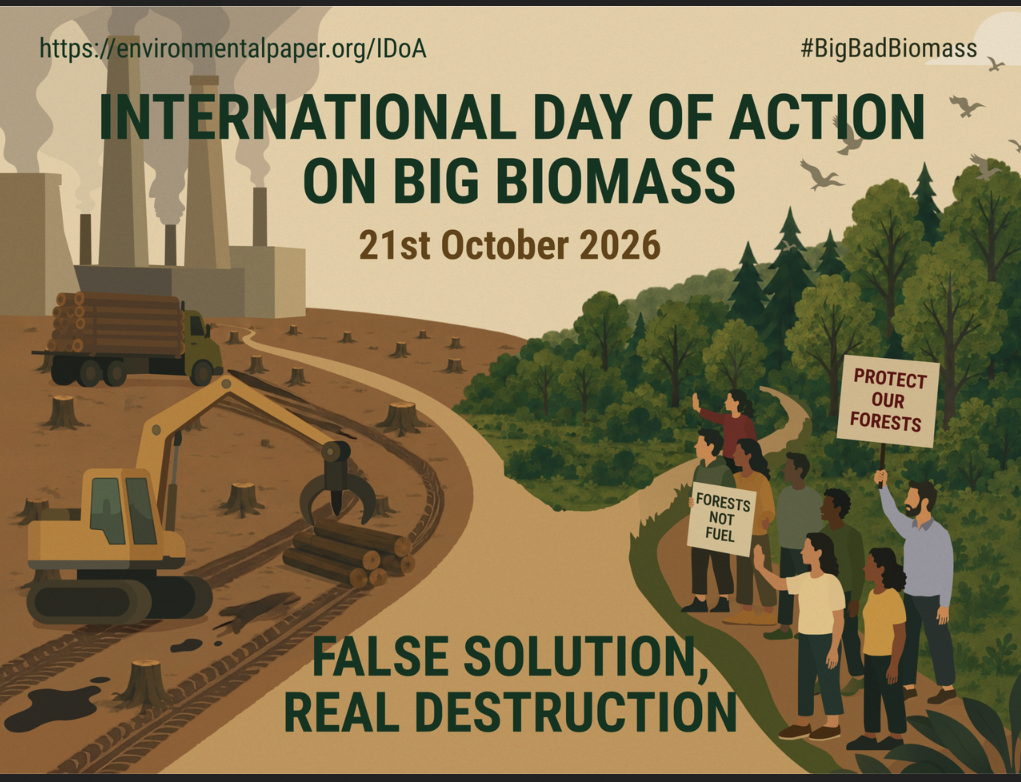
International Day of Action On Big Biomass
On 21 October 2026, people and organisations around the world protested against the burning of forests to generate heat and electricity.
They called on governments and companies to put an end to greenwashing and misinformation about woody biomass, and to stop the burning of forests and subsidies for wood burning.
The facts are clear and scientifically proven: wood burning harms the climate, people and forests, and blocks a genuine, clean energy transition.
In Switzerland, too, the government and the timber lobby are trying to cover up the truth about wood burning and its devastating consequences by every means possible.
The Cascading Use of Wood- the Swiss Fairy Tale
Welcome to Switzerland: the land of pristine alpine lakes, punctual trains and “eco-friendly” forestry where the trees are so sustainable they practically volunteer to walk into the wood chipper.
Take Buttisholz, Canton of Lucerne, home to Switzerland’s largest wood pellet plant, with a production capacity of up to 180,000 tons a year. The PR story is beautifully tidy: pellets made purely from the “scraps” of the ultra-modern sawmill next door, made possible by Switzerland’s strict, 150-year-old ban on clearcutting. You can practically hear the alphorns.
Now let’s look at the maths:
A plant this size needs an estimated 300,000+ tons of raw wood annually. Of which, roughly 260,000+ tons of wet raw material get pressed into retail pellets, with a further 30,000–50,000 tons of bark, lower-grade timber and construction waste burned on-site to generate the heat needed to dry the pellets.
Do the hypothetical maths on that 350,000-ton volume (at an official average standing timber reserve of 350 m³/ha) and it equals the total standing biomass of up to 1,350 hectares of mature spruce and fir forest razed to the dirt.
Not that clearcutting happens in Switzerland. If you raze a massive patch but intend to let it regrow, say as a “climate-fit” forest, the law treats it differently from a classic clearcut.
According to federal statistics, sawmills received nearly 70% of the Swiss timber harvest in 2003. By 2025, that fell to 45%—energy wood has reached full parity with sawlog use for the first time. Fuel wood’s share of the harvest has doubled in two decades. And the official figures cover only logs and woodchips; processed pellets hide inside the sawmill data. The true slice going to energy is likely even bigger.
So much for the “cascading use of wood” principle—the official policy that wood should serve long-lasting products first and be burned only as a last resort.
As sawlog and energy-wood prices converge and with sawmills facing high labour and sorting costs, the net margin of sending wood to the pellet mill versus the saw bench looks increasingly similar.
But the real engine is the federal CO₂ incentive levy. When natural gas or heating oil is burnt, a levy of 120 CHF per tonne of CO₂ is payable. As the burning of wood is legally classified as ‘climate-neutral’, no levy is payable. A truly successful incentive scheme: That asymmetry gives corporations every reason to swap fossil boilers for biomass burners and compete for the same wood the timber industry needs.
When burning becomes a compliance strategy rather than a last resort, pressure mounts on the very assortment that houses and furniture are made of—and the cascading-use principle quietly erodes.
So the next time you see a bag of premium, “carbon-neutral” Swiss pellets, remember the journey: a tree, selectively thinned for the climate, processed through a tax shelter and compressed into a neat little pellet. All to keep corporate balance sheets as green as the countryside.
Position Paper Reveals Wood Burning as a Fatal Error in Climate Strategy
A position paper published on September 22 reveals wood burning as a fatal error in the EU’s climate strategy. Read more in our new article about the fraud in CO2 balances, the collapse of carbon sinks, the threat to biodiversity, the ignorance of health risks, and the hypocrisy behind environmental justice.
As a reminder: Switzerland, too, is relying on wood burning in the fight against climate change.
Position paper highlights fatal errors in the EU’s climate strategy
A critical new position paper—co-signed by 44 NGOs—dropped on 22 September 2026 ahead of the EU Renewable Energy Directive revision. It exposes a fatal flaw in EU climate strategy that nobody’s naming loudly enough.
Policy incentives introduced to slash emissions have done the opposite. Since 2001, biomass has become the EU’s largest “renewable” energy source—driving up emissions, stunting clean tech adoption and actively harming the European economy. That’s some impressive reverse engineering, really.
What the data actually shows:
- The Carbon Accounting Fraud: Wood burning is not carbon neutral. Biomass combustion emits more CO₂ per unit of energy than coal at the point of combustion. Emissions from biomass have doubled since 2001. Trees burn in seconds but take decades to regrow—this CO₂ accumulates faster than any forest can reabsorb. The math is simple. The accounting? Not so much.
- The Collapsing Carbon Sink: The EU now burns 47% of its entire annual wood harvest. Over-logging has turned many European forests from carbon sinks into carbon sources. The EU’s forest carbon sink has plummeted 43% since 2001—putting the bloc at risk of missing its own LULUCF climate targets. Talk about a sink-or-swim moment for the EU’s credibility.
- Biodiversity Under Fire: Legislation rewards burning any wood, financially incentivising clear-cutting of entire ecosystems—including trees with no commercial market. This destroys wildlife habitats, collapses biodiversity and degrades forests’ natural capacity to regulate water cycles, cool local climates and purify air. The policy only makes sense if you’re running a clear-cutting business plan.
- Health Toxicity Ignored: Wood smoke is scientifically proven to be more toxic than secondhand tobacco smoke and more mutagenic than exhaust fumes, triggering respiratory failure, heart disease and strokes. Major European cities are banning wood burning to protect people—while EU subsidies pay companies billions to pump it into our air. Inhale this, it’s renewable!
- Environmental Justice Abroad: The EU’s demand for wood pellets relies heavily on imports from places like the US Southeast and, increasingly, Asia. Marginalised communities there face chronic asthma from living next to 24/7 pellet manufacturing mills. So we’re exporting our green problems abroad. How very circular.
- Innovation Suffocated: By making bioenergy artificially cheap for energy companies, the EU delays expansion of genuinely clean alternatives: solar, wind, geothermal, heat pumps.
Accounting tricks won’t stop global warming. The root cause is fixable—we just need to stop branching out excuses. It’s time to move funding away from burning carbon-rich fuels, redirect toward insulation/storage/grid upgrades and continuous-cover forestry, and align policy with actual atmospheric science.
Because at this point, the only thing truly sustainable about EU biomass policy is the scandal.
October 2026
More and more countries are banning advertising for wood stoves as supposedly environmentally and climate-friendly
Australia’s advertising regulatory authority is following the example of the United Kingdom (latest news dated May 8, 2026) and has ruled against a wood stove manufacturer which advertised on its website that heating with a modern wood-burning system does not release smoke or other carbon-rich gases and does not contribute to the greenhouse effect.
In its ruling, the advertising regulator states: New, modern wood heating systems emit just as many pollutants as they did 20 years ago. To support its decision, the advertising regulator presented tests, several documents and studies proving that wood burning (regardless of the system used) emits more CO2 than oil or gas.
In Switzerland, however, countless companies—as well as organisations and government agencies—advertise that wood burning is sustainable and CO2-neutral. The harmful emissions are conveniently ignored.
Photo: Air polluted by wood heating in Switzerland, harmful to the climate, the environment, and human health
Our scouts are being given their own email address
We have set up a new email address for everyone who helps us uncover malpractices.
From now on, photos, videos, and articles – whether your own or forwarded – that expose malpractices can be sent to scout@health-and-forest.org.
We would like to thank you for your valuable and excellent cooperation in the fight against greenwashing and disinformation when it comes to health and forests.
Everyone can get involved.
Photo from our scouts: Vast numbers of felled trees in the Lake Murten region, which can no longer fulfil their role as climate regulators, drinking water reservoirs, CO₂ sinks and biodiversity hotspots. Instead, burning them releases CO₂ that has been stored for decades and pollutes the air in a way that is harmful to health.
Air pollution as a cause of death: New law for clean air aims to ban wood burning
Air pollution is the greatest environmental risk, emphasises the management of the organisation Mums for Lungs. It is linked to asthma, cancer and dementia, costs vast sums of money and harms everyone, including the economy.
Stephen Holgate, Special Adviser on Air Quality to the Royal College of Physicians, puts it plainly: we now know that particles from wood burning are more harmful than those from coal. Together with 60 organisations representing over 230,000 members, he is calling for a ban on wood burning (including in new eco-design stoves) and an end to the influence of the wood-burning lobby.
Since February 2026, wood burning has officially been classified as carcinogenic in Europe. In Switzerland, however, wood burning continues to be promoted and subsidised, whilst the truth about modern wood heating systems and the effect of wood burning on health, the environment and the climate is being concealed.
Photo: Ella Kissi-Debrah, who died in 2013 at the age of nine, was the first person in the world to be officially listed as having died from air pollution. A draft bill on human rights in relation to air quality has been informally dubbed ‘Ella’s Law’. Photo: Family archive/PA, published in The Guardian.
Nature conservation organisation BirdLife Switzerland allows advertising for forest burning
Nature needs your commitment: with this slogan BirdLife is recruiting new members, patrons and donations to protect birds and their habitats.
At the same time, BirdLife allows the Basel-based energy company ADEV– which also burns forests to generate heat – to advertise in its magazine *Ornis* for energy that is supposedly ecological, sustainable and climate-friendly.
This is consistent with the organisation’s commitment to promoting ‘open’ forests. This is because energy wood production requires large-scale clear-cutting (usually carried out under the guise of the entirely unscientific “climate adapted forest management”’) – the main cause of forest damage and deforestation, and thus also responsible for the loss of habitat for countless birds. Not to mention that too much light causes massive damage to the forest.
Members and donors must ask themselves whether they wish to invest their money in organisations that promote the destruction of vital habitats and biodiversity hotspots, especially as in many regions (the Bernese Mittelland, the Bernese Jura, Basel, Zurich) more trees are already being cut down than are regrowing.
Natural wood isn’t the only fuel used in Swiss fireplaces – but all types of waste
The Federal Ordinance on Air Pollution Control (OAPC) classifies wood under four different types: natural wood; wood residues (from sawmills); used wood (from demolition/construction sites) and recycled wood (such as old furniture) and stipulates that only natural wood can be burnt in unfiltered installations.
While burning all types of wood releases pollutants, the last three categories emit vast quantities of dioxins and heavy metals (lead, chromium, zinc and copper), as well as hazardous halogenated organic compounds in the case of used wood. Demolition and recycled wood emit the most pollutants, with up to 4 times and 16 times more lead and zinc respectively than the 5 mg/m3 mandated by the OAPC. High levels of pentachlorophenol (PCP) and chlorine are also emitted into the atmosphere, and are also found in the residual ash.
Wood residues, used wood and recycled wood should only be burnt in furnaces equipped with special filters therefore.
But many people are either unaware of the law or wilfully ignore it. Cases have even been documented of old furniture being burnt and of recycling yards being raided for discarded furniture and other treated wood to burn in home stoves.
Even domestic rubbish is burnt in fireplaces to avoid having to purchase bin bags (which are taxed in Switzerland).
In grape growing regions such as the Valais, vine stocks are sometimes burnt in home fireplaces along with all the chemicals they’ve been doused in, to save having to pay to burn them industrially. And very often the resulting ash is then used to fertilise vegetable patches and gardens!
But even burning natural wood produces pollutants. Indeed the size, moisture content and tree species of both wood logs and woodchips can greatly impact their combustion, as indeed can the type of wood stove and whether it has been properly maintained or not.
Burning wet wood for example produces more pollutants, more ash and two times less energy or heat than burning dry wood. Burning 500 kg of wet wood could theoretically pollute an area of 100 hectares in size. Yet some people actually water their log piles to keep the wood wet so that it burns longer.
According to the Federal Office for the Environment (FOEN): “Domestic wood burners are not subject to periodic measurement. However, if they are used regularly, a visual inspection is carried out every two years (less frequently for rarely-used systems) to check that the combustion system is being operated correctly, and in particular with the right fuel.”
Such inspections are conducted both by chimney sweeps and specially trained officials, but not enough tests are being done and, with chimney sweeps booking their slots with home owners in advance, there is little chance of catching the latter red handed.
Tests carried out on some 2,100 biomass-fired district heating systems in central Switzerland revealed that 15.43% did not conform to the OAPC. A similar result (16% non-conformity) was found in the canton of Bern where 4,000 burners are tested each year.
Regardless of maintenance, the use of filters or the type of wood, the pollutants produced by wood burning are extremely harmful to health, both for the person burning the wood and for people in the immediate and wider vicinity.
Finally, although district heating systems do mostly come with filters, they are much less effective than those found on waste burning plants and some unscrupulous operators have been known to turn the filters off; burn wet woodchips or power their burners up at night when the wood smoke released is less visible.
It is past time to transition to emissions-free heat sources.
September 2026
Not just natural wood in Swiss wood-burning stoves – but also all kinds of waste
Regardless of how well the wood-burning stove is maintained, whether filters are used or which type of wood is burnt, the pollutants produced by wood combustion are extremely harmful to health , both for the person burning the wood and for people living in the immediate and wider surroundings.
Read our new article in the ‘We expose’ section to find out why burning wood scraps, waste wood and recycled wood is prohibited, and why many people do not comply with the law.