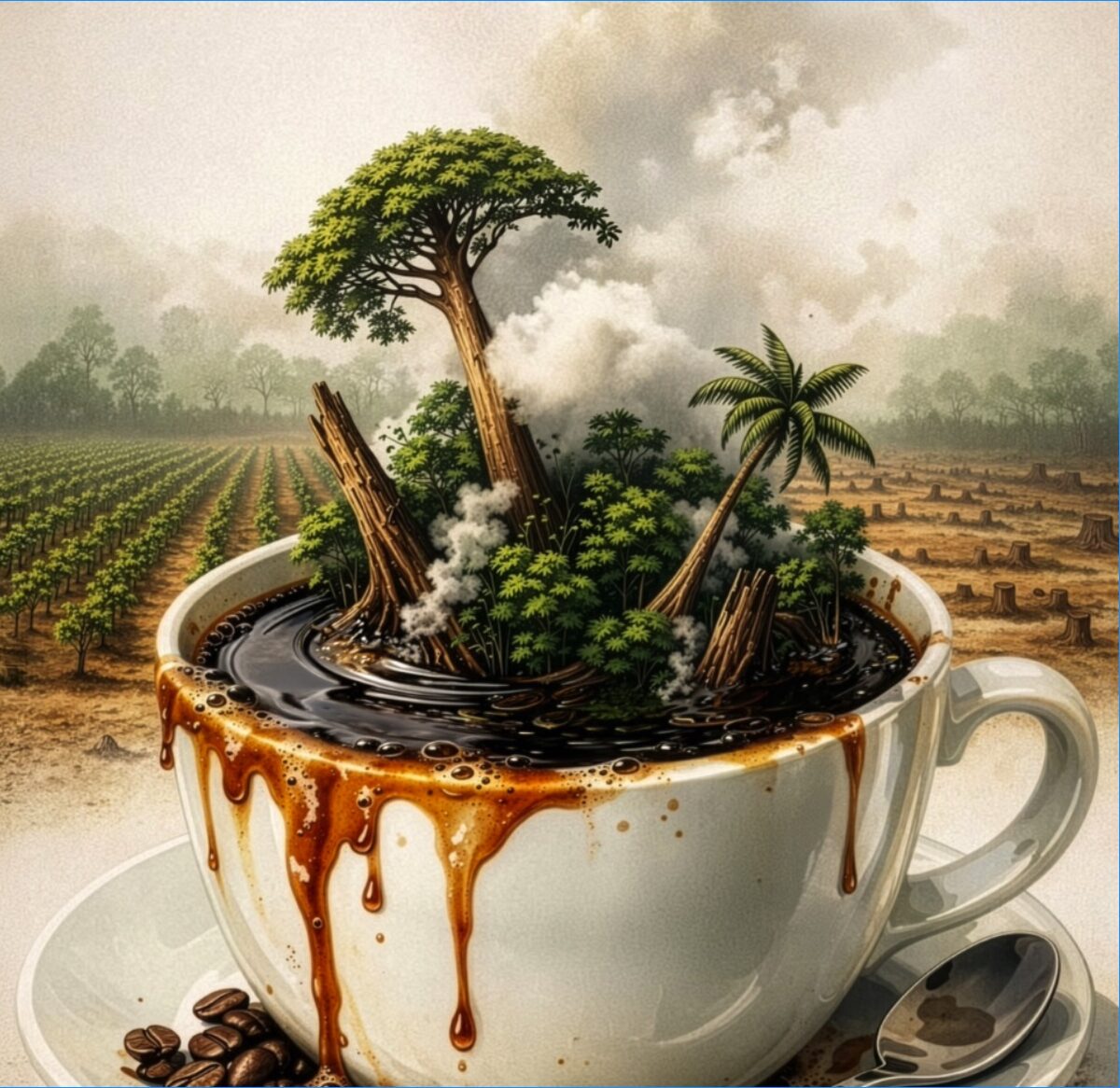
Coffee is the sixth largest driver of global deforestation
Love your morning brew? A new study by Deutsche Umwelthilfe in cooperation with Coffee Watch has filtered out the bitter truth behind the world’s third most popular beverage.
To satisfy our caffeine cravings, nearly 2 million hectares of forest were cleared between 2001 and 2015 making coffee the sixth most significant contributor to the loss of our planet’s forests. The EU, which consumes 24% of the world’s coffee, is responsible for up to 40% of the associated deforestation.
Switzerland consistently ranks among the top 10 coffee-consuming nations per capita at 7.9kg of coffee beans per year per person… some 1.6-2.9 cups of coffee per person, per day.
Each sip carries a footprint.
We are trading ancient biodiverse forests for monocultures that rely on 150 different pesticides, half of which are so toxic they are banned in the EU. Meanwhile, the farmers—the very people exposed to these toxins—receive as little as 1% of the retail price. Over 5.5 million farmers are living below the poverty line, earning less than $3.20 a day…
… less than the price of your average cappuccino.
The study revealed that while brands such as Alnatura, JDE Peet’s, Seeberger and Tchibo were making strides toward transparency, others like J. J. Darboven, Bela and Dallmayr were lagging behind.
Coffee plants are fussy, requiring 15–24°C temperatures and altitudes ranging from 1,800 to 2,600 metres. And they are thirsty, needing 1,500-2,500 mm of rainfall annually. Yet coffee is often grown in regions that are already prone to water stress, competing directly with the needs of local communities for drinking water and other essential agriculture and setting up a water debt that is becoming increasingly unsustainable in a warming world.
Processing the coffee cherries requires yet more water.
The most common method to extract the bean within is to soak and ferment the mucilage—the sticky, sugar-rich layer of the coffee cherry—before washing it away. The resulting waste water is known as “aguas mieles,” but there is nothing sweet about these honey waters which represent a significant environmental pollutant if not managed correctly.
The unfiltered truth is that every single cup of coffee requires 140 litres of water to produce.
And, after outsourcing the environmental destruction and the labour, we ship the beans home to Europe (usually by boat—only 5% of the world’s coffee is transported by air freight) to roast and make the real profit. It’s a lucrative cycle that the industry is desperate to protect, so corporate interests are currently leveraging their political weight to stall and weaken the EU Deforestation Regulation.
Succumbing to caffeinated clichés may be hard to swallow, but brewing a crisis for decades while forests vanish and farmers across the Global South face poverty means there’s no choice left: it’s time to wake up and smell the coffee.
Image: Deutsche Umwelthilfe & Coffee Watch
March 2026