The Cascading Use of Wood- the Swiss Fairy Tale
Welcome to Switzerland: the land of pristine alpine lakes, punctual trains and “eco-friendly” forestry where the trees are so sustainable they practically volunteer to walk into the wood chipper.
Take Buttisholz, Canton of Lucerne, home to Switzerland’s largest wood pellet plant, with a production capacity of up to 180,000 tons a year. The PR story is beautifully tidy: pellets made purely from the “scraps” of the ultra-modern sawmill next door, made possible by Switzerland’s strict, 150-year-old ban on clearcutting. You can practically hear the alphorns.
Now let’s look at the maths:
A plant this size needs an estimated 300,000+ tons of raw wood annually. Of which, roughly 260,000+ tons of wet raw material get pressed into retail pellets, with a further 30,000–50,000 tons of bark, lower-grade timber and construction waste burned on-site to generate the heat needed to dry the pellets.
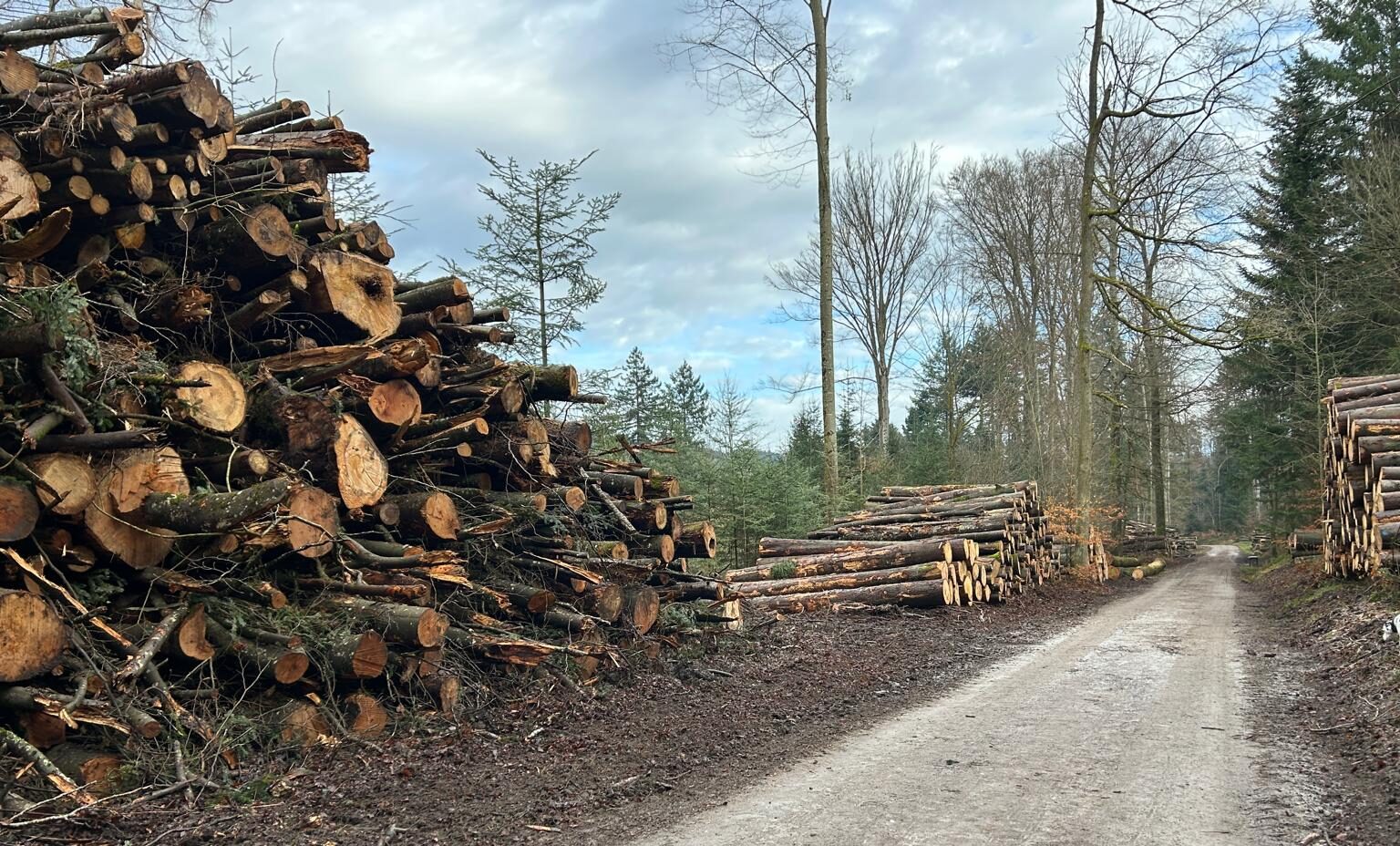
Do the hypothetical maths on that 350,000-ton volume (at an official average standing timber reserve of 350 m³/ha) and it equals the total standing biomass of up to 1,350 hectares of mature spruce and fir forest razed to the dirt.
Not that clearcutting happens in Switzerland. If you raze a massive patch but intend to let it regrow, say as a “climate-fit” forest, the law treats it differently from a classic clearcut.
According to federal statistics, sawmills received nearly 70% of the Swiss timber harvest in 2003. By 2025, that fell to 45%—energy wood has reached full parity with sawlog use for the first time. Fuel wood’s share of the harvest has doubled in two decades. And the official figures cover only logs and woodchips; processed pellets hide inside the sawmill data. The true slice going to energy is likely even bigger.
So much for the “cascading use of wood” principle—the official policy that wood should serve long-lasting products first and be burned only as a last resort.
As sawlog and energy-wood prices converge and with sawmills facing high labour and sorting costs, the net margin of sending wood to the pellet mill versus the saw bench looks increasingly similar.
But the real engine is the federal CO₂ incentive levy. When natural gas or heating oil is burnt, a levy of 120 CHF per tonne of CO₂ is payable. As the burning of wood is legally classified as ‘climate-neutral’, no levy is payable. A truly successful incentive scheme: That asymmetry gives corporations every reason to swap fossil boilers for biomass burners and compete for the same wood the timber industry needs.
When burning becomes a compliance strategy rather than a last resort, pressure mounts on the very assortment that houses and furniture are made of—and the cascading-use principle quietly erodes.
So the next time you see a bag of premium, “carbon-neutral” Swiss pellets, remember the journey: a tree, selectively thinned for the climate, processed through a tax shelter and compressed into a neat little pellet. All to keep corporate balance sheets as green as the countryside.