Spring logging: Switzerland doesn’t seem to need forest birds or silence
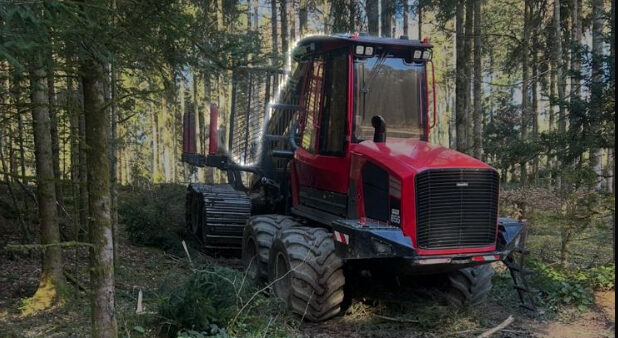
Is there anything more uplifting than the sound of wood harvesters and chippers drowning out bird song during peak nesting season?
While “old school” ecologists cling to the idea that spring is for nesting birds, breeding mammals, spawning amphibians and emerging flora, modern Swiss forest management is taking a much more… mechanical approach.
The uptick in 30-tonne harvester usage during the peak breeding season is particularly common in the canton of Bern where logging occurs virtually all year round, presumably to amortise its growing lignin lugging fleet.
Shockingly, spring timber removal is also being carried out in nature reserves, including the internationally important Belpau Emerald Network which ironically abuts the Swiss capital where the Bern Convention was once ratified, long, long ago.
Two of the worst offenders and curators of many hectares of public forests include the Staatsforstbetrieb Bern (SFB) and the canton’s various Burgergemeinden. Despite their claims to be preserving forests for future generations, the SFB has also been caught spraying rioting brambles with glyphosate while the Burgergemeinde Bern’s website openly admits to cutting trees in spring.
From 1 April – 15 July, forest users are instructed to stick to paths and keep dogs on leads, while heavy machines unbound by any constraints are free to compact and churn the forest floor and evict nesting birds and bats from their old trees.
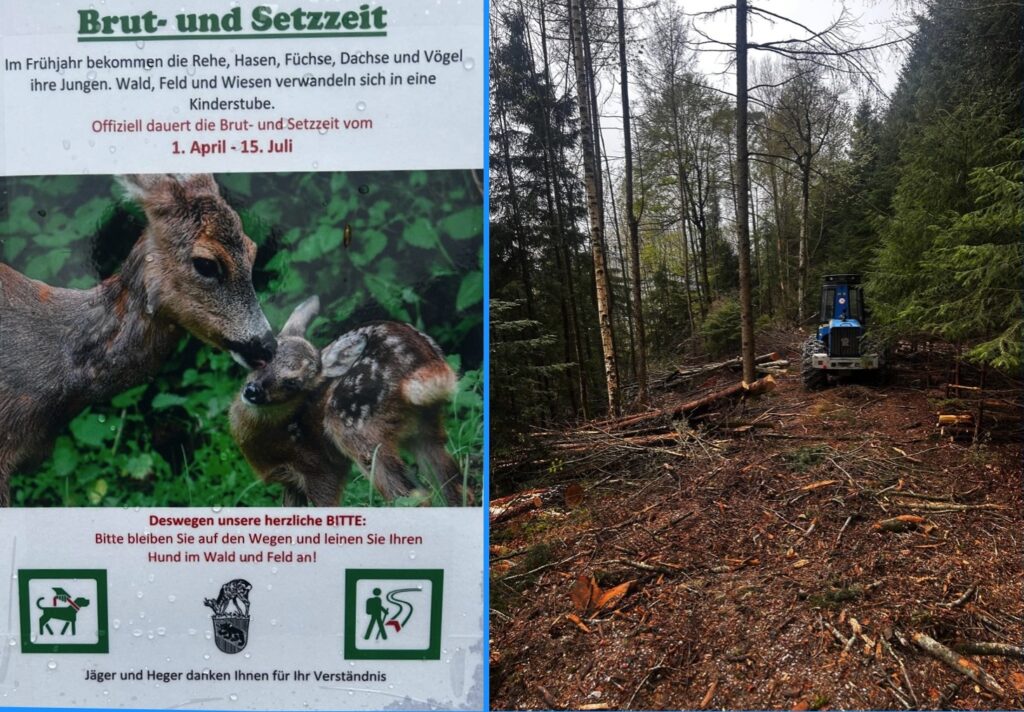
The Federal Act on Forest (Art.18) prohibits the use of “environmentally hazardous substances” in forests and the Hunting law (LChP – Art. 17) warns of fines and even prison sentences for anyone “disturbing birds during the nesting season.”
In 2021, the Court of Justice of the European Union (or easier to understand here (scroll down quite far)) ruled that logging during the breeding season was an “intentional destruction” of bird nests because forest owners were aware that birds breed in forests. In Switzerland, however, the gamekeepers state that, absurdly, destroyed nests or eggs must be found on the ground to prove that the brood has been disturbed.
You’d think this was obvious. A singing bird is a sure sign of a territory and a nest.
As early as 2023, formal reports regarding these apparent habitat violations were submitted to mainstream NGOs. Their response? Not merely inaction, but a continued failure to condemn the practice.
Spring in Switzerland arrives up to 10 days earlier so we are graciously helping nature keep pace with our chainsaws. We step in to ensure trees are cut down before they get too old, preventing forests from becoming inconveniently biodiverse or stubbornly dense with carbon.
The Federal Office for the Environment advocates that forests must fulfil “diverse functions.” Yet, in a testament to focused priorities, over 81% of Swiss forest policy actors agree that the functional priority must remain harvesting wood over carbon sequestration or ecological naturalness.
All ecosystem functions may very well be equal, but some are clearly more equal than others. Quite an Orwellian turn in our pragmatic Swiss forest management.
In Switzerland, we don’t preserve woodland habitats, we protect revenue streams.
May 2026
Photo: Agent Green